
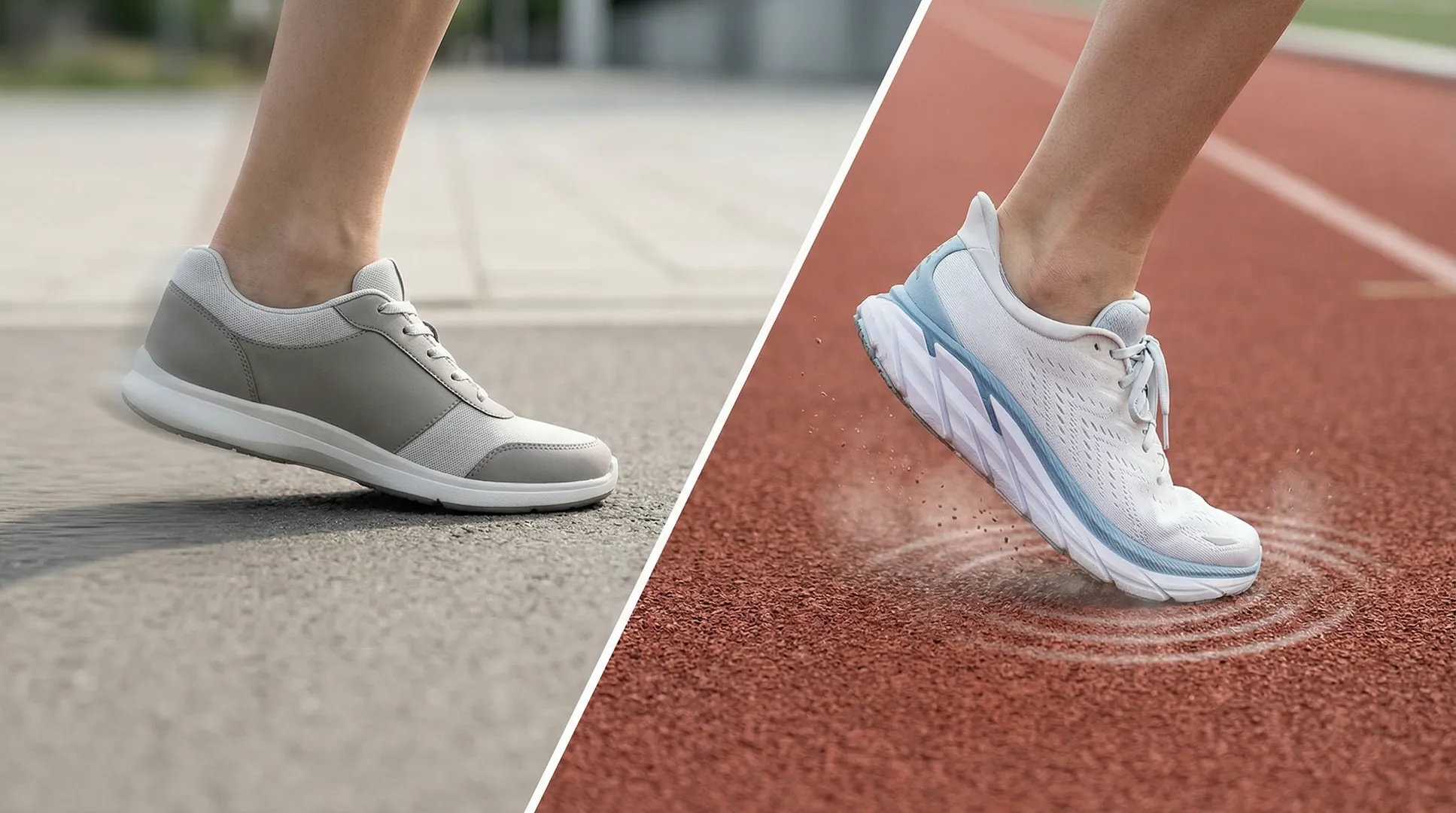

For many fitness beginners in the country, it’s tempting to just “run in your walking shoes.” After all, they look similar, cost money, and technically both are athletic footwear.
But this can do you more harm than good. Because, walking and running are fundamentally different biomechanics, and using walking shoes for running regularly can actually increase your injury risk, reduce performance, and slow progress.
Below, we explore why this matters scientifically, and how to pick the right shoes for your goals.
This guide breaks down the best walking shoes in the world, trusted across the country, with clear verdicts on who each shoe is perfect for, whether you walk for fitness, commute daily, or stay on your feet all day.
1. Walking vs Running: The Biomechanical Reality
Walking
- One foot is always in contact with the ground.
- Motion is a heel-to-toe roll.
- Impact forces are relatively low, comfortable walking is gentle on joints. (Harvard Health)
Running
- Both feet leave the ground with each stride.
- Impact forces spike with every foot strike: up to 2–3× body weight. (Mochi-Shoes)
- The body must absorb shock repeatedly, increasing demands on muscles, joints, and connective tissues.
This fundamental difference means running shoes are designed not just for movement, but for impact absorption and propulsion, features walking shoes aren’t optimized for.
2. Scientific Evidence: Shoes Matter for Impact & Injury
A. Cushioning and Injury Risk
A large-scale research project tracking thousands of running sessions showed that runners with less cushioning had up to 52% higher injury risk, particularly to ankles and knees. (Luxembourg Institute of Health)
Another study of 527 runners found that perceived higher cushioning comfort correlated with significantly lower injury risk. (PMC)
Takeaway: Running shoes intentionally include cushioning that absorbs shock and may help lower injury risk, something typical walking shoes lack.
B. Shoe Structure & Biomechanics
Running footwear research highlights how shoe design changes running mechanics. Heel-to-toe drop (difference in height from heel to forefoot) and sole stiffness significantly influence joint loading patterns. (MDPI)
That means running and walking shoes affect:
- how your foot hits the ground
- how your knees and ankles absorb load
- your stride pattern and muscle engagement
Wearing the wrong shoes (like walking shoes for running) can misalign these biomechanics, putting undue strain on joints over time.
C. Expert Consensus
Harvard Health and other medical authorities explicitly state the correct rule:
“Running shoes are designed to have thicker soles that act as shock absorbers… because of these differences, running shoes can be used for walking, but you should not run in walking shoes.” (Harvard Health)
That’s not a sales tagline, it’s based on how footwear geometry intersects with gait mechanics.
3. Key Differences at a Glance
|
Feature |
Walking Shoes |
Running Shoes |
|
Impact Forces |
Low |
High (up to 3× bodyweight) (Mochi-Shoes) |
|
Cushioning |
Light/Moderate |
Extra with shock absorption layers (Decathlon) |
|
Heel-to-Toe Drop |
Low |
Typically higher, optimized for running gait (Nike.com) |
|
Outsole & Grip |
Durable for walking surfaces |
Designed for traction at faster speeds |
|
Flexibility Pattern |
More rigid for controlled roll |
Flexible where needed for propulsion |
|
Risk for Running |
Higher injury risk long-term |
Lower injury risk if matched to runner |
4. What Happens If You Run in Walking Shoes?
Shock Absorption Is Insufficient
Without adequate cushioning and midsole tech:
- bones and joints take more direct load
- you’re more likely to feel soreness or shin pain
- guidance from cushioning studies shows this correlates with injury risk (PMC)
Stride Efficiency Drops
Running shoes are engineered to propel you forward, and even small mismatches in geometry can reduce efficiency and increase fatigue.
Increased Risk of Overuse Injuries
Over time, repetitive impact can contribute to:
- shin splints
- knee pain
- plantar fasciitis
- Achilles irritation
These are exactly the problems better cushioning and support aim to mitigate.
5. When Can You Occasionally Run in Walking Shoes?
Short, casual runs (e.g., <1 km) for fun or warm-up are okay, but regular running and training are different. If your beach walk turns into a jog and it’s a one-off, you’re probably safe.
Just don’t rely on walking shoes as your primary running gear.
6. Best Walking Shoes vs Running Shoes: Picks You’llLove
I’ve curated three walking shoes great for comfort and everyday wear, and three running shoes designed to handle impact and reduce injury risk.
Top 3 Walking Shoe Picks (Comfort & Daily Wear)
(Great for India’s varied walking contexts, street, mall, outdoor strolls)
- Skechers GOwalk Series: Plush comfort, excellent for long steps.
- Puma Softride / Walking Sneakers: Sporty + cushioned for day-to-day life.
- Adidas Cloudfoam Walking Shoes: Balanced cushioning with classic styling.
These excel at comfort and stability but are not engineered for repeated high-impact running.
Top 3 Running Shoe Picks
- ASICS Gel-Contend / Gel-Excite: Stable, cushioned, great first runner.
- Nike Revolution Series: Lightweight with shock absorption.
- Adidas Duramo Series: Good all-round cushioning and support.
These brands invest in running-specific midsole technologies that handle repeated impact forces.
7. How to Choose Shoes Based on Goals
✔ Primary activity is walking? Pick walking shoes: comfort is key.
✔ Mix of walking + light jogging (<3 km)? A beginner running shoe still beats walking shoes for joints.
✔ Regular running / training? Always go with a running-specific shoe.
Running shoes are okay for walking, but walking shoes are not designed for running, especially not for repeated stress.
Summary
So if you care about safety, comfort, performance, and long-term running consistency, investing in the right shoes is always worth it.